
If you're looking for a speaker platform — whether to find speakers for your event or to get booked as a speaker — you've probably come across SpeakUp, eSpeakers, and SpeakerHub. All three serve the professional speaking industry, but they work very differently. This comparison breaks down what each platform actually does, how they differ, and which one makes sense for your situation.
Quick Comparison Table
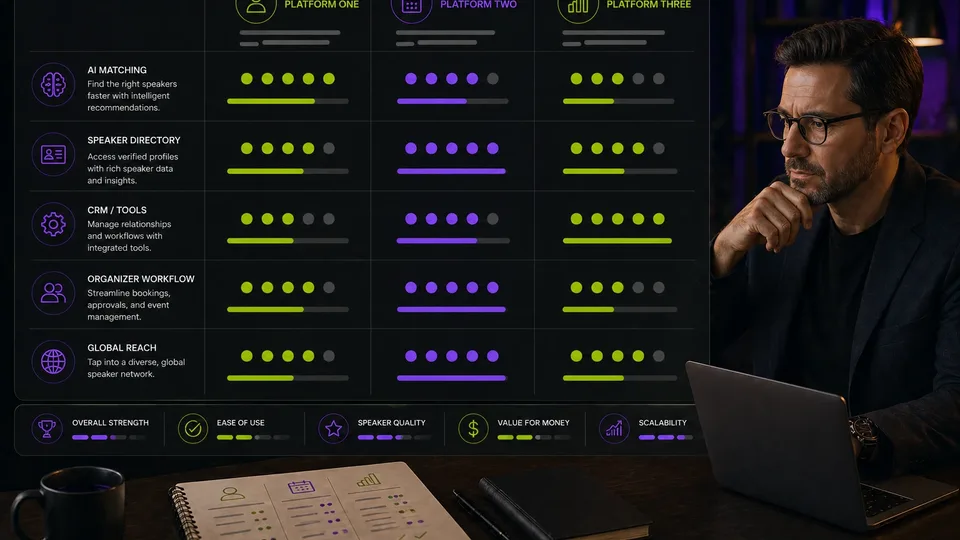
Founded: SpeakUp — 2023 (Dubai); eSpeakers — 1999 (US); SpeakerHub — 2015 (US).
Model: SpeakUp — Two-sided marketplace; eSpeakers — Marketplace + speaker SaaS; SpeakerHub — Speaker tools + outreach CRM.
Speaker directory size: SpeakUp — 30,000+; eSpeakers — 10,000+; SpeakerHub — Thousands (undisclosed).
AI matching: SpeakUp — Yes; eSpeakers — No; SpeakerHub — No (AI pitch writing only).
For organizers: SpeakUp — Search, post requests, AI matching; eSpeakers — Search, browse, contact; SpeakerHub — Browse directory.
For speakers: SpeakUp — Profile, inbound matching; eSpeakers — Profile, CRM, bureau syndication; SpeakerHub — Profile, CRM, outbound pitching.
Covers podcasts/media: SpeakUp — Yes; eSpeakers — Limited; SpeakerHub — Yes (pitch-based).
Free for organizers: SpeakUp — Yes; eSpeakers — Yes; SpeakerHub — Yes (directory only).
Speaker pricing: SpeakUp — Free basic, premium optional; eSpeakers — $399+/year for Pro; SpeakerHub — $49+/month, lifetime deals.
Global coverage: SpeakUp — 50+ countries (MENA, US, EU, India); eSpeakers — US-heavy, global; SpeakerHub — Global.
Commission: SpeakUp — None; eSpeakers — None; SpeakerHub — None.
SpeakUp
SpeakUp is an AI-powered platform designed for both sides of the equation: event organizers looking for speakers and speakers looking for opportunities. It covers conferences, podcasts, and media — a broader scope than most competitors.
How it works for organizers: You can search the speaker directory using filters, post a speaker request describing your event, or let AI matching suggest relevant speakers automatically. When you post a request, the algorithm notifies speakers who fit your criteria, and interested speakers apply directly. You review their profiles, message through the platform, and confirm the booking — all without leaving SpeakUp.
How it works for speakers: You create a profile with your bio, topics, videos, and availability. AI matching then surfaces your profile to organizers with relevant events. You receive notifications when there's a match, and can apply to opportunities or respond to direct invitations. The platform also works for podcast guest opportunities and media expert requests — not just conference keynotes.
Strengths:
- AI matching saves time for both sides — organizers get curated results, speakers get relevant inbound leads
- Covers events, podcasts, and media in one platform — no need for separate tools
- No commissions or booking fees for either side
- Strong in MENA (Dubai-based, partnerships with GITEX, Dubai Chambers), plus growing in US, Europe, and India
- Built-in chat, booking confirmation, and review system
Limitations:
- Newer platform — less brand recognition than eSpeakers in the US speaking industry
- Speaker business tools (CRM, invoicing, contract management) are less developed than eSpeakers or SpeakerHub
- Content and educational resources for speakers are still being built out
Best for: Organizers who want fast AI-matched results without bureau commissions. Speakers who prefer inbound opportunities over cold outreach. Anyone who needs speakers for podcasts or media, not just conferences.
eSpeakers
eSpeakers is the veteran of the speaker platform space. Founded in 1999, it's the most established marketplace and the closest thing to an industry standard for professional speakers in the US.
How it works for organizers: Browse the marketplace by topic, fee range, location, and availability. View speaker profiles, watch video clips, and contact speakers directly. eSpeakers also offers a "post your event" feature where speakers can discover your event and express interest.
How it works for speakers: Create a profile on the eSpeakers marketplace. A Pro account ($399+/year) enhances your ranking in search results, syndicates your profile to 50+ partner directories, and provides an all-in-one event management system (EventCX) for handling inquiries, contracts, payments, travel, and A/V logistics. eSpeakers also integrates with speaker bureaus, giving Pro speakers visibility through bureau channels.
Strengths:
- Longest-running platform — 26 years of industry trust and the largest established speaker network
- Bureau integrations give speakers exposure through traditional booking channels
- EventCX is a comprehensive business management system (calendar, contracts, payments, logistics)
- 60-day success program for new speakers learning the platform
- Strong eSEO tools — internal ranking optimization similar to SEO for search engines
Limitations:
- No AI matching — organizer search is manual browse-and-filter
- Interface feels dated compared to newer platforms
- Primarily US-focused — international coverage is growing but not a core strength
- Pro account pricing ($399+/year) is a significant commitment for emerging speakers
- Speaker profiles vary in quality — no strict verification process
Best for: Professional speakers in the US who want maximum directory exposure and bureau connections. Speakers who need a full business management system (contracts, payments, logistics). Organizers who prefer a traditional search-and-browse approach.
SpeakerHub
SpeakerHub has repositioned itself as an "authority platform for experts and founders." It's primarily a speaker-side tool — built to help speakers get booked through proactive outreach rather than waiting to be found.
How it works for organizers: You can browse SpeakerHub's directory and view SpeakerPAGEs (individual speaker profiles). These pages are SEO-optimized, so they often appear in Google searches for speaker names and topics. However, the organizer experience is secondary to the speaker tools — there's no AI matching, no request posting system, and limited organizer-specific features.
How it works for speakers: SpeakerHub gives you a SpeakerPAGE (an SEO-optimized profile on their high-authority domain) plus a suite of outreach tools. SpeakerLEADS provides a database of event planners, podcast hosts, and media contacts. SpeakerGPT helps you write personalized pitches. SpeakerCRM tracks your conversations and follow-ups. SpeakerCTA collects verified audience reviews after your talks.
Strengths:
- Strongest outreach tools of any platform — built for speakers who want to actively pitch
- SpeakerPAGEs rank well on Google (high domain authority, structured for SEO)
- SpeakerGPT AI assistant writes tailored pitches in your voice
- Lead database of 3M+ event planners, podcast hosts, and media contacts
- SpeakerCTA audience feedback system builds verified social proof
- Active community with coaching sessions and training
Limitations:
- Primarily a speaker tool — organizer discovery experience is minimal
- Requires speakers to do outbound work (pitching, following up) — not passive
- Monthly subscription ($49+/month) adds up, though lifetime deals are available
- The system works best for speakers who are consistent with outreach — occasional use delivers limited results
- Not a true marketplace — it's more of a CRM and lead generation system
Best for: Speakers who want to actively manage their own booking pipeline. Experts, authors, and founders who use speaking as a lead generation channel. Speakers who are comfortable with outbound outreach and want AI-assisted pitching tools.
Key Differences
For Event Organizers
SpeakUp is the strongest option for organizers. It's the only platform of the three with AI matching, request posting, and a genuine two-sided marketplace. eSpeakers offers a large browsable directory but requires manual search. SpeakerHub is primarily a speaker tool — organizers can browse profiles, but the platform isn't built around the organizer workflow.
For Speakers
All three serve speakers, but through different philosophies. SpeakUp brings opportunities to you (inbound, AI-matched). eSpeakers maximizes your visibility across directories and bureaus (passive exposure). SpeakerHub equips you to go get opportunities yourself (outbound, CRM-driven). The best approach may be using SpeakUp for inbound and SpeakerHub for outbound simultaneously.
Pricing
SpeakUp is the most accessible — free for both sides, with optional premium features. eSpeakers requires a $399+/year Pro subscription for meaningful features. SpeakerHub charges $49+/month (or a one-time lifetime deal) for access to outreach tools and lead databases. For speakers on a tight budget, SpeakUp offers the lowest barrier to entry.
AI and Technology
SpeakUp is the only platform with AI matching for organizers — it analyzes event requirements and surfaces relevant speakers automatically. SpeakerHub uses AI for pitch writing (SpeakerGPT) but not for organizer-side discovery. eSpeakers uses an internal ranking algorithm (eSEO) but doesn't offer AI matching.
Global Coverage
SpeakUp has the broadest international presence — strong in MENA, US, Europe, and India, with speakers from 50+ countries. eSpeakers is primarily US-focused with growing international reach. SpeakerHub's lead database includes international contacts, but the community and content are US-centric.
Which Platform Should You Choose?
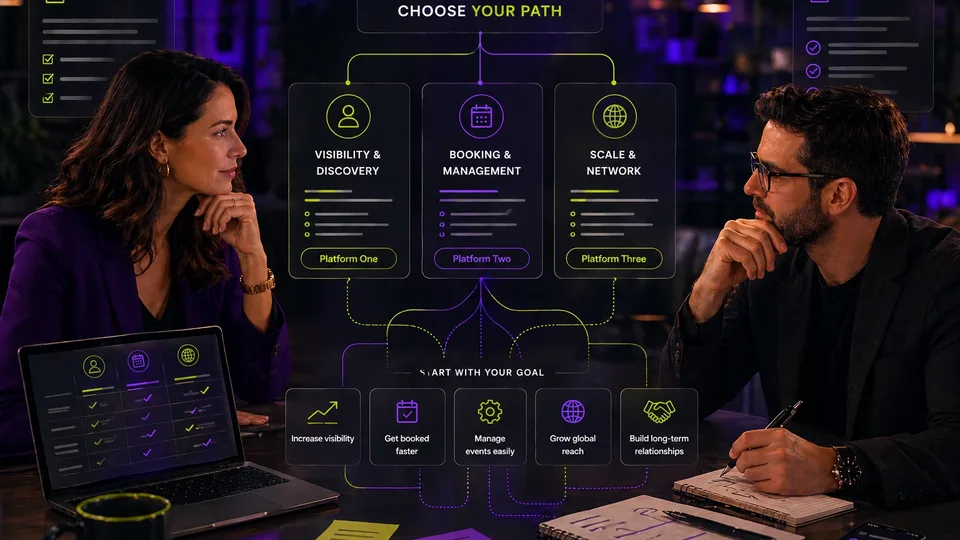
If you're an event organizer looking to find and book speakers quickly: start with SpeakUp. AI matching and request posting give you the fastest path to finding relevant, available speakers — for conferences, podcasts, and media.
If you're a speaker who wants inbound opportunities without spending hours on outreach: create a profile on SpeakUp. AI matching notifies you of relevant opportunities automatically.
If you're a speaker who wants maximum US directory exposure and bureau connections: invest in an eSpeakers Pro account. The directory syndication and EventCX tools justify the cost for full-time professional speakers.
If you're a speaker who wants to actively pitch and control your own outreach: add SpeakerHub. The CRM, lead database, and AI-assisted pitching tools are built for this approach.
If you want to cover all bases: Use SpeakUp for inbound AI matching + SpeakerHub for outbound pitching + eSpeakers for directory visibility. Many successful speakers use multiple platforms simultaneously — they're not mutually exclusive.
FAQ
Is SpeakUp a good alternative to eSpeakers?
Yes, especially for organizers and speakers who want AI-powered matching. SpeakUp's AI surfaces relevant speakers based on event details automatically, while eSpeakers requires manual search. SpeakUp is also free for both sides (no $399/year Pro subscription), covers podcasts and media (not just conferences), and has stronger international coverage. eSpeakers has the advantage of a larger established directory and bureau integrations.
Which platform is best for new speakers?
SpeakUp is the easiest starting point — free profile creation, no subscription required, and AI matching brings opportunities to you without outreach experience. For new speakers who want to actively learn the speaking business, SpeakerHub's coaching resources and community add value, though the $49/month cost is a consideration when you're just starting.
Can I use multiple speaker platforms at once?
Absolutely, and most successful speakers do. Each platform reaches a different audience of organizers. Having profiles on SpeakUp, eSpeakers, and SpeakerHub simultaneously maximizes your visibility. Just make sure your profiles are consistent across platforms — same headshot, bio, topics, and video clips.
Which platform has the best AI features?
SpeakUp has the most advanced AI matching for organizer-speaker connections — it analyzes topics, industries, languages, event formats, and speaker availability to generate matches automatically. SpeakerHub offers SpeakerGPT for AI-assisted pitch writing, which is useful for outreach but doesn't help organizers discover speakers. eSpeakers doesn't currently offer AI-powered features.