
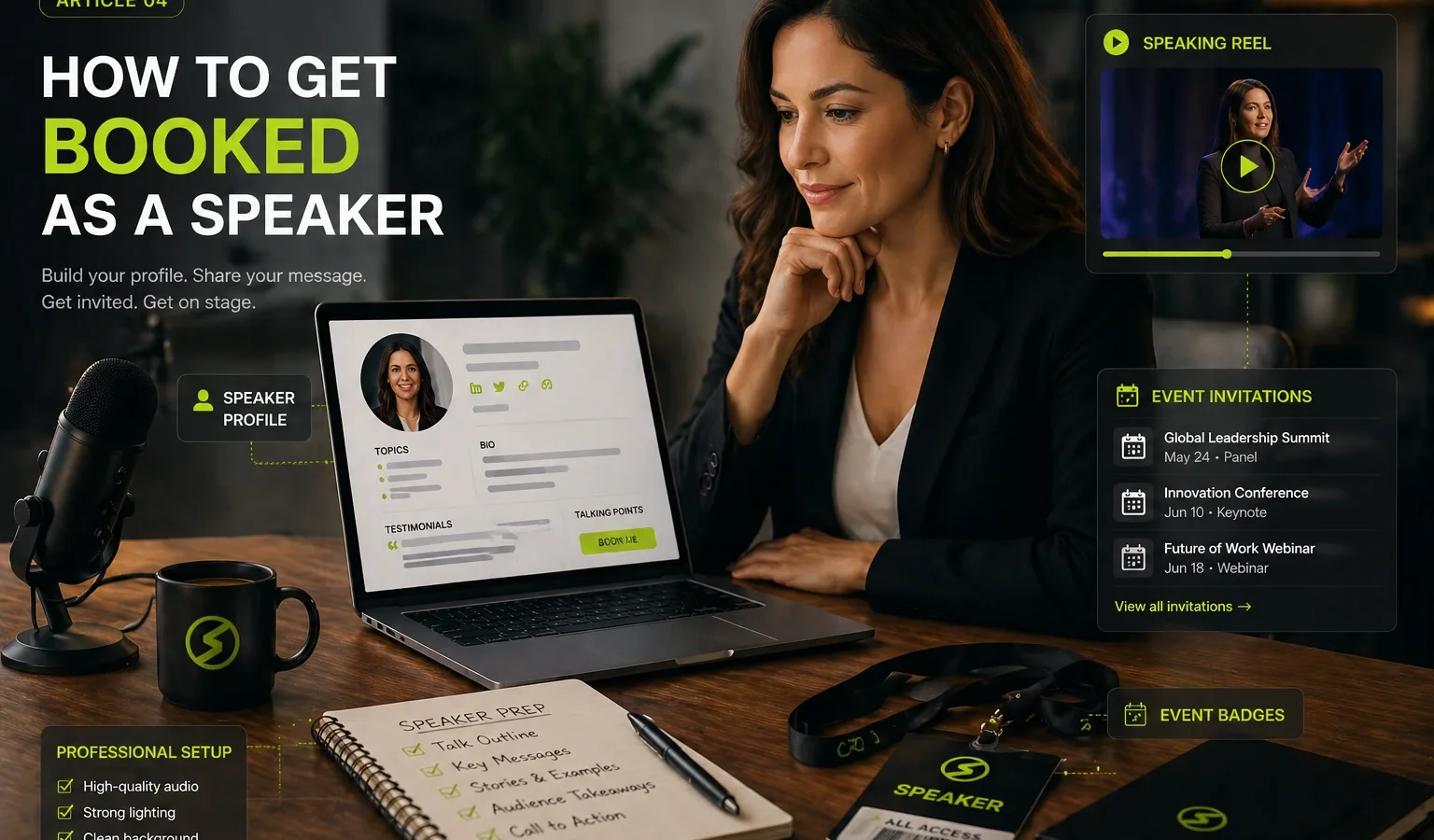
You're great on stage. Your content is solid. You've gotten standing ovations. But the bookings aren't coming in fast enough — or at all. This is the most common frustration among professional speakers, and the reason is almost always the same: getting booked is a visibility problem, not a talent problem. Event organizers can't book you if they can't find you. This guide covers 10 strategies that working speakers actually use to get discovered, get shortlisted, and get booked — whether you're just starting out or looking to scale from 10 gigs a year to 50.
Why Getting Booked Is Harder Than Being Good on Stage
The speaking industry has a paradox: there are more events than ever — conferences, podcasts, webinars, corporate training, media interviews — but also more people calling themselves speakers. Standing out requires more than expertise. It requires a system.
Event organizers typically spend 15–30 minutes researching each speaker candidate. In that time, they look at your profile, watch a video clip, scan reviews, and check if you've spoken at events they recognize. If any of these elements are missing — or hard to find — they move on to the next name on their list.
The speakers who consistently get booked aren't always the best presenters. They're the most findable, most credible, and easiest to evaluate.
10 Proven Ways to Get Speaking Gigs
1. Create a Professional Speaker Profile
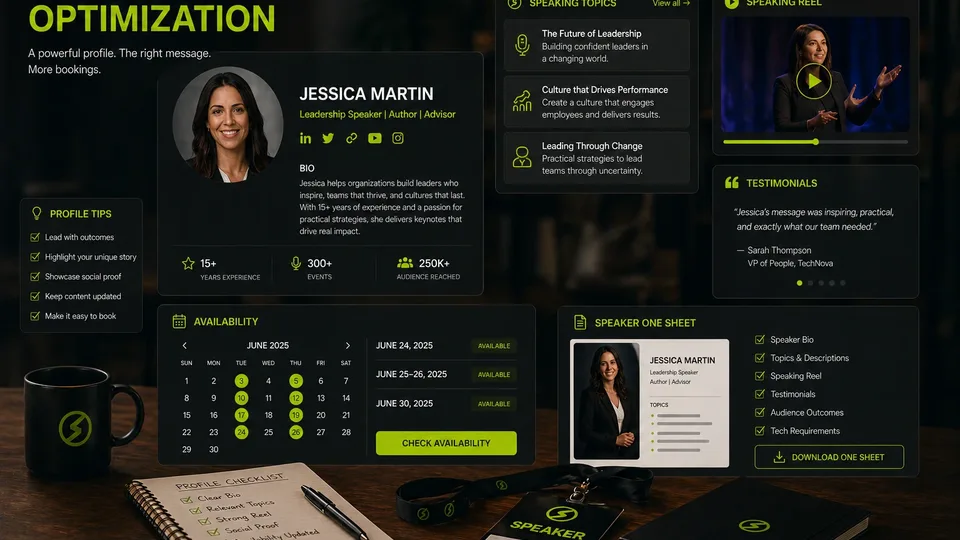
Your speaker profile is your storefront. Without it, you're invisible to the vast majority of event organizers. A strong profile includes: a professional headshot, a clear bio focused on your expertise (not your life story), 3–5 specific speaking topics with descriptions, at least one high-quality video of you presenting, testimonials or ratings from past events, and your availability and fee range.
SpeakUp's speaker profile lets you build all of this in one place — visible to organizers, podcasters, and journalists worldwide. Once created, AI matching surfaces your profile to relevant opportunities automatically.
2. Join Speaker Booking Platforms
Don't rely on a single channel. List yourself on multiple platforms to maximize exposure. The three most relevant in 2026 are SpeakUp (AI-powered matching, global, events + podcasts + media), eSpeakers (largest established directory, bureau integrations), and SpeakerHub (outreach tools and CRM for self-managed bookings).
Each platform has a different strength. SpeakUp brings opportunities to you through AI matching. eSpeakers gives you visibility across 50+ directories. SpeakerHub helps you actively pitch to event planners. Using all three covers both inbound and outbound channels.
3. Build a Speaker One Sheet / EPK
A speaker one sheet (also called an Electronic Press Kit) is a single-page PDF that summarizes who you are, what you speak about, and why an organizer should book you. Think of it as a professional resume for speaking. Include your headshot, bio, 2–3 talk titles with descriptions, notable past events, a testimonial, and contact information.
Send your one sheet when responding to speaking opportunities, include it in email pitches, and make it downloadable from your website. Some speakers use their SpeakUp profile as a digital one sheet — it contains the same information in a searchable, shareable format.
4. Start with Podcasts and Panels
If you're early in your speaking career, podcasts are the fastest way to build a portfolio. Podcast hosts are always looking for guests, episodes create permanent searchable content, and you get practice communicating your ideas in a structured format.
Panels at industry events are another low-barrier entry point. You're sharing the stage with other experts, so there's less pressure, but you still get event experience, audience feedback, and a line item for your speaker resume.
Post a speaker profile on SpeakUp and set your availability for podcasts and panels — organizers actively search for these formats.
5. Leverage LinkedIn for Visibility
LinkedIn is where event organizers research speakers. Regularly post content related to your speaking topics: short insights, frameworks, contrarian takes, and clips from past presentations. Tag events you've spoken at. Engage with posts from conference organizers and event professionals in your industry.
Over time, this builds a body of searchable content that organizers find when they Google your name or your topic. The goal is that when an organizer lands on your LinkedIn profile, they immediately see: this person knows their subject and can present it compellingly.
6. Apply to Call-for-Speakers
Many conferences — especially in tech, education, and professional development — use open call-for-speakers (CFP) processes. Platforms like Sessionize list active CFPs across industries. Industry associations often announce CFPs through their newsletters and websites.
When applying, don't send a generic proposal. Tailor your submission to the specific conference: reference their audience, align your topic with their theme, and explain why your perspective is unique. Include a link to a video of you presenting — proposals with video get selected at significantly higher rates.
7. Speak for Free to Build Your Portfolio
Early in your career, strategic pro bono speaking builds the assets you need to charge later: video footage, testimonials, audience data, and event logos for your portfolio. The key word is strategic — speak for free at events where your target audience attends, not at every local meetup.
Set a timeline: speak for free for 3–6 months while building your materials, then transition to paid engagements. Some speakers use a hybrid approach — free keynote in exchange for the right to sell their book, course, or consulting at the event.
8. Get Testimonials and Video Clips
Every gig should produce two things: a video clip and a testimonial. Ask the organizer to record your talk (even a smartphone clip is better than nothing). After the event, email the organizer and ask for a written testimonial within 48 hours — while the experience is fresh.
Build a library of 30-second and 3-minute clips from different events. The 30-second clip works for social media and quick pitches. The 3-minute clip shows organizers your stage presence, audience engagement, and content quality. The full recording lives on your profile or YouTube for those who want to see the complete presentation.
9. Network at Industry Events
Attend conferences as a participant, not just a speaker. Introduce yourself to event organizers, fellow speakers, and industry leaders. Many speaking opportunities come through personal connections — an organizer who saw you contribute a great question during a Q&A, a fellow speaker who recommends you for an event they can't attend, or a colleague who mentions your name when their company is looking for a keynote.
Follow up after every event. Connect on LinkedIn, send a brief message referencing your conversation, and stay visible. The speaking world runs on relationships — many of the highest-paid speakers got their start through a single referral.
10. Use AI Matching to Get Discovered
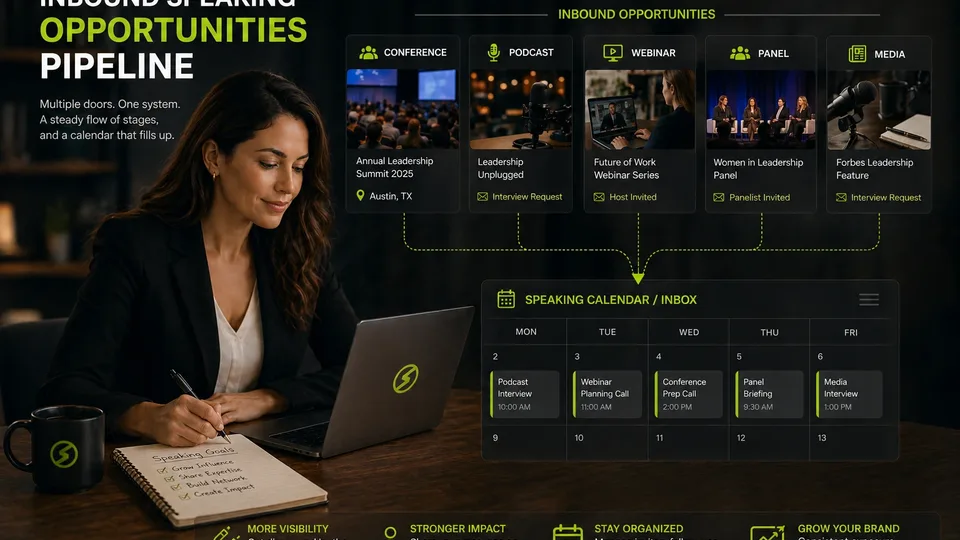
Instead of only pitching outbound, let technology bring opportunities to you. Platforms with AI matching analyze your profile — topics, industry, location, language, availability — and automatically match you with relevant event requests. When an organizer posts a request for "an AI expert for a Dubai conference in March," speakers who fit that description get notified instantly.
This is the most efficient strategy for speakers who want a steady flow of inbound opportunities without spending hours on outreach every week. The quality of matches depends on the completeness of your profile — the more detail you provide, the better the algorithm can match you.
What Event Organizers Look for When Booking a Speaker
Understanding the buyer's perspective gives you a major advantage. Here's what organizers consistently prioritize:
Topic relevance. Does the speaker's expertise directly align with the event theme and audience needs? A vaguely related topic gets passed over in favor of a precise match.
Proof of expertise. Not just credentials, but demonstrated knowledge — through published content, industry experience, or previous talks on the same subject.
Video evidence. Organizers want to see you on stage. A polished demo reel is good, but a full unedited talk from a real event is even more convincing.
Ratings and reviews. Verified feedback from past organizers carries more weight than self-written testimonials on your website.
Availability and logistics. Is the speaker available on the event date? Are they located nearby (saving travel costs), or willing to travel? Do they handle their own logistics professionally?
Pricing transparency. Organizers don't want to go through three rounds of emails to find out your fee. Make your pricing clear — on your profile, your one sheet, or in your first response to an inquiry.
Speaker Profile Checklist
Before launching your outreach or listing on any platform, make sure you have these essentials:
- Professional headshot (high resolution, event-appropriate attire)
- Speaker bio (150–300 words, expertise-focused, third person)
- 3–5 speaking topics with 2–3 sentence descriptions each
- At least one video clip of a real presentation (minimum 3 minutes)
- 2–3 testimonials from past event organizers or attendees
- Clear fee range or pricing model
- Contact information or booking link
- Social proof: logos of past events, media features, or publications
Missing even one of these makes organizers hesitate. Complete profiles get booked. Incomplete profiles get skipped.
FAQ
How do I get my first speaking gig?
Start with low-barrier opportunities: podcast guest appearances, industry meetup presentations, local chamber of commerce events, or company lunch-and-learn sessions. You can also post a free speaker profile on SpeakUp and mark yourself as available for free or reward-based engagements. Many first gigs come through your professional network — tell colleagues, clients, and industry contacts that you're available to speak.
Which platforms help speakers get booked?
The three most effective platforms in 2026 are SpeakUp (AI matching brings opportunities to you), eSpeakers (largest directory with bureau exposure), and SpeakerHub (outreach tools for self-managed pitching). For tech speakers, Sessionize is essential for conference CFPs. Using multiple platforms maximizes your visibility across different organizer audiences.
How much can I charge as a speaker?
Emerging speakers typically charge $1,000–$5,000 per keynote. Professional speakers with a track record charge $5,000–$20,000. Top-tier speakers with strong name recognition command $20,000–$100,000+. Your fee should reflect your experience, demand for your topic, and the value you deliver. Start at a rate that gets you booked consistently, then raise it as demand grows and your portfolio strengthens.
Do I need a speaker bureau to get booked?
No. Bureaus are one channel, but not a requirement. Many successful speakers manage their own bookings through platforms, direct outreach, and referrals. Bureaus are most useful for speakers targeting the $25,000+ fee range, where the bureau's relationships with corporate event planners justify their 20–30% commission. For speakers at earlier stages, platforms and personal networking are more effective and cost-free.
How do I create a speaker one sheet?
A speaker one sheet is a single-page PDF with your headshot, bio (100–150 words), 2–3 talk titles with brief descriptions, notable past events, one strong testimonial, and contact information. Keep it clean and visual — event organizers should be able to scan it in 30 seconds. Design tools like Canva have speaker one sheet templates, or you can use your SpeakUp profile as a digital alternative.