
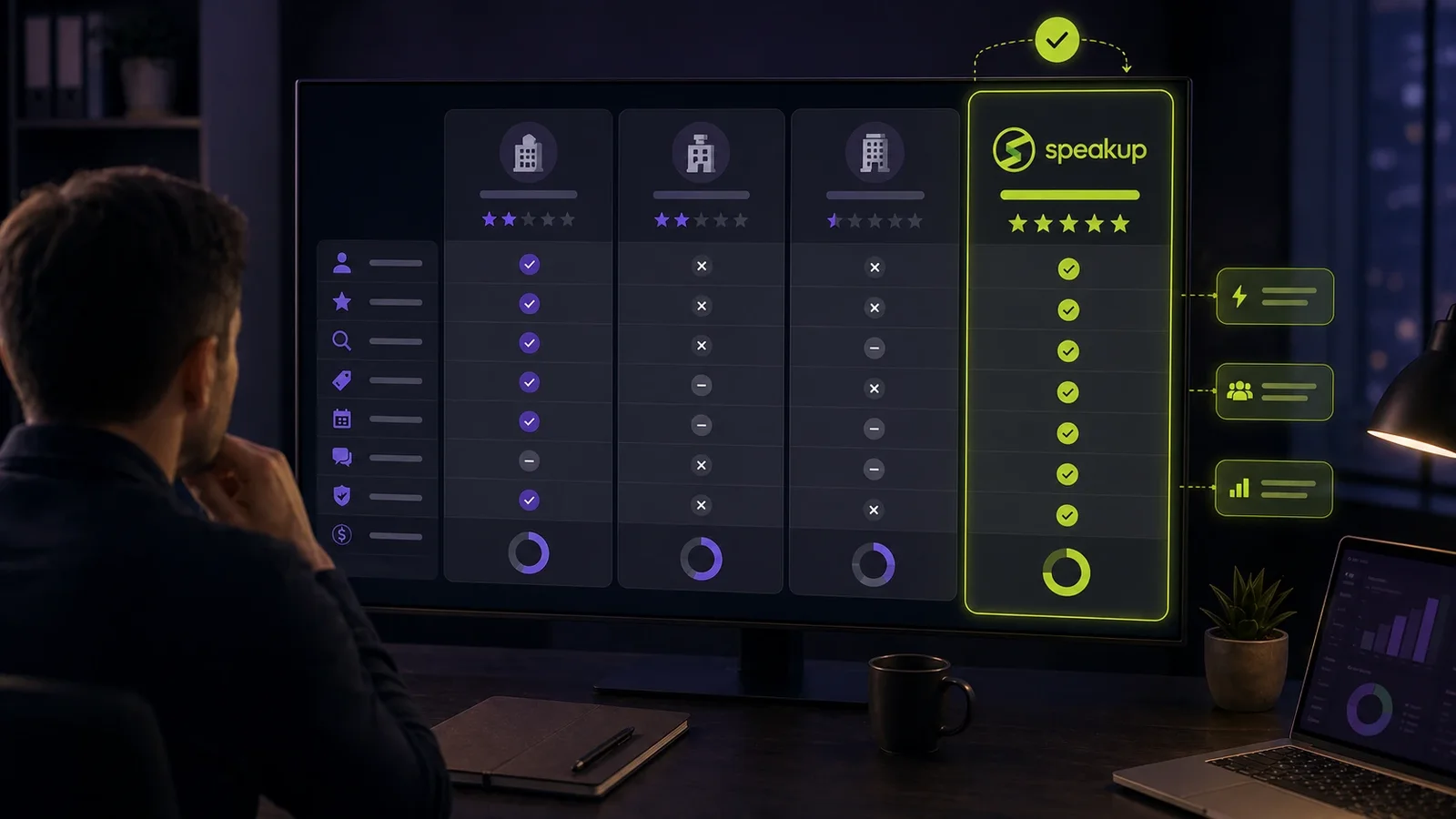
Whether you're an event organizer searching for a keynote speaker or a speaker looking to get booked, the platform you choose matters. Each one works differently — some focus on organizers, some on speakers, some on both. Pricing models vary, AI features differ, and geographic coverage is uneven. This comparison covers seven platforms that are actively used in 2026, with an honest breakdown of what each does well, where it falls short, and who it's best for.
What to Look for in a Speaker Booking Platform
Before diving into individual platforms, here are the five criteria that matter most:
Speaker quality and verification. How does the platform vet speakers? Are profiles verified, or can anyone sign up? Do speakers have ratings, reviews, and video clips you can evaluate?
Matching technology. Does the platform help you find speakers, or do you have to browse manually? AI-powered matching can save hours by surfacing relevant speakers based on your event's topic, audience, and format.
Pricing transparency. Can you see speaker fees before reaching out? Are there platform commissions on top of the speaker's fee? Some platforms are free for organizers, others charge subscription fees or per-booking commissions.
Ease of use. How quickly can you go from "I need a speaker" to "I've booked one"? The best platforms streamline communication, contracts, and logistics in one place.
Global coverage. If your events span multiple countries and languages, you need a platform with international speakers — not just US-based talent.
The 7 Best Speaker Booking Platforms
1. SpeakUp — AI-Powered Matching for Events, Podcasts, and Media
SpeakUp is a two-sided marketplace that connects event organizers, podcasters, and media teams with verified speakers using AI matching. Founded in Dubai, the platform has grown to 70,000+ verified speaker profiles across 30+ countries.
Key features: AI matching by topic, industry, language, location, and availability. Organizers can post speaker requests and receive applications. Built-in chat and booking confirmation. Speaker profiles include bio, topics, demo videos, ratings, and reviews.
Pricing: Free for organizers — no commissions, no subscription. Speakers can create a free profile. Premium features available for speakers wanting enhanced visibility.
Pros: AI matching is genuinely useful, especially for time-pressed organizers. The platform covers events, podcasts, and media — most competitors focus on only one. Direct communication without middlemen. Strong presence in MENA, US, Europe, and India.
Cons: Newer platform, so the speaker directory is smaller than eSpeakers'. No bureau integrations. Limited content marketing or educational resources (as of 2026).
Best for: Organizers who want fast, AI-matched results without bureau commissions. Speakers who prefer inbound opportunities over cold outreach.
2. eSpeakers — Established Marketplace with Bureau Integrations
eSpeakers has been in the market since 1999, making it one of the longest-running speaker platforms. It operates as both a marketplace for organizers and a business management tool for speakers.
Key features: Marketplace with 10,000+ speakers. Advanced search filters by topic, fee range, location, and availability. EventCX system for managing contracts, payments, and logistics. Integration with speaker bureaus. Speaker SEO tools and directory syndication.
Pricing: Free basic listing for speakers. Pro accounts ($399+/year) unlock enhanced features, ranking boost, and bureau visibility. Organizers can use the marketplace for free.
Pros: Largest established database. Deep event management features for speakers. Bureau integrations mean speakers get exposure through multiple channels. 26 years of industry trust.
Cons: Interface feels dated compared to newer platforms. The sheer volume of speakers can make finding the right one slow without clear filters. Speaker profiles vary in quality. No AI matching — search is manual.
Best for: Speakers who want maximum directory exposure and bureau connections. Organizers who prefer a traditional search-and-browse approach.
3. SpeakerHub — Profile Platform with Outreach Tools
SpeakerHub positions itself as an "authority platform for experts and founders." It combines speaker profiles (called SpeakerPAGEs) with outreach tools, CRM, and a lead database that lets speakers proactively pitch to event planners and podcast hosts.
Key features: SEO-optimized speaker profile pages. SpeakerCRM for managing outreach and follow-ups. SpeakerGPT for AI-assisted pitch writing. Lead database of event planners and podcast hosts. SpeakerCTA for collecting audience feedback.
Pricing: Free SpeakerPAGE with basic features. Paid plans start at $49/month for outreach tools and lead access. Lifetime deals available. No fees for organizers using the directory.
Pros: Strong SEO — SpeakerPAGEs often rank on Google for speaker name searches. Comprehensive business tools for speakers. Active community and coaching resources. The outreach system is genuinely differentiated.
Cons: Primarily speaker-focused — organizer experience is secondary. The platform pushes speakers to do outbound work (pitching), which isn't for everyone. Organizer-facing search and discovery is less developed. No AI matching for organizers.
Best for: Speakers who want to actively manage their own booking pipeline. Experts and founders who use speaking as a lead generation tool.
4. GigSalad — Broad Talent Marketplace
GigSalad is a general entertainment and talent marketplace covering speakers, musicians, performers, DJs, and more. It books 10,000+ performers across the US and Canada.
Key features: Broad talent search with speaker-specific filters. Quote request system — post your event and receive proposals. Reviews and ratings. Booking management tools.
Pricing: Free for event planners to post and browse. Speakers pay a membership fee ($150–$300/year) plus a booking fee on confirmed gigs.
Pros: Huge volume of talent across categories. Strong in the US market. Good for events that need both speakers and entertainment. Simple quote-and-book flow.
Cons: Speakers are mixed with DJs, magicians, and performers — not a dedicated speaker platform. Less depth in speaker vetting. No AI matching. Limited international coverage (US and Canada only). Speaker profiles are less detailed than dedicated platforms.
Best for: US-based events that need a mix of speakers and entertainment. Corporate events, galas, and parties. Not ideal for finding subject-matter experts or conference keynote speakers.
5. Sessionize — Call-for-Speakers for Tech Conferences
Sessionize is a call-for-speakers (CFP) platform designed for tech conferences and community events. It lets organizers publish CFPs, manage submissions, and coordinate speaker logistics.
Key features: CFP management with custom submission forms. Submission review and voting tools. Speaker scheduling and session management. Speaker profile directory. Free for community events.
Pricing: Free for community events. Paid plans for commercial conferences ($499–$999 per event). Free for speakers to submit.
Pros: Best-in-class CFP management. Strong in the tech community — most major tech conferences use Sessionize. Clean interface with good scheduling tools. Speakers can discover and apply to open CFPs.
Cons: Primarily for tech events — limited use outside of tech. Not a booking platform in the traditional sense (organizers post CFPs, speakers apply). No AI matching. No speaker search for organizers — it's submission-based only. No built-in payment or contract management.
Best for: Tech conference organizers who want a CFP management system. Tech speakers who want to find and apply to conference CFPs.
6. Talkadot — Data-Driven Speaker Profiles with Audience Feedback
Talkadot approaches speaker booking from a unique angle: real-time audience feedback. Speakers use Talkadot to collect ratings, testimonials, and engagement data after every talk, building a data-backed profile that event planners can evaluate.
Key features: QR-code based audience feedback collection. AI-powered lead identification from attendees. Data-driven speaker profiles with verified audience ratings. Integration with CRMs via Zapier. Automated follow-up tools.
Pricing: Free to try (basic features). Paid plans for advanced analytics, lead capture, and profile features.
Pros: Unique value proposition — no other platform offers verified audience data at this level. Testimonials are collected automatically, removing friction. Useful for speakers who want to prove their ROI to event planners. Strong integration ecosystem.
Cons: More of a speaker performance tool than a booking platform. Organizer-facing discovery features are limited. Smaller speaker directory than eSpeakers or SpeakUp. Best value only after speakers have used it at multiple events.
Best for: Experienced speakers who want data to justify higher fees and repeat bookings. Organizers who want evidence-based speaker selection.
7. SpeakerFlow — CRM and Business Tools for Speakers
SpeakerFlow is an all-in-one business platform built specifically for professional speakers. It combines CRM, pipeline management, website builder, email marketing, contract generation, and payment processing.
Key features: Speaker-specific CRM with pipeline tracking. No-code website builder. Automated proposal and contract generation. Email marketing. Payment processing. Integrations with major business tools.
Pricing: Subscription-based plans starting at $49/month. No organizer-facing search or marketplace.
Pros: Most comprehensive business toolset for speakers. Strong CRM and pipeline features. Good for speakers who manage their own bookings and want everything in one platform. Active community and educational content.
Cons: Not a marketplace — organizers cannot find speakers here. Purely a speaker-side business tool. No AI matching, no discovery, no directory. Requires significant setup and learning curve.
Best for: Full-time professional speakers who want to manage their business operations in one platform. Not suitable for organizers looking to find speakers.
Platform Comparison Table
AI matching: SpeakUp — Yes; eSpeakers — No; SpeakerHub — No.
Organizer search: SpeakUp — Yes; eSpeakers — Yes; SpeakerHub — Limited.
Speaker profiles: SpeakUp — Verified; eSpeakers — Self-service; SpeakerHub — SEO-optimized.
Free for organizers: SpeakUp — Yes; eSpeakers — Yes; SpeakerHub — Yes.
Speaker tools: SpeakUp — Basic; eSpeakers — Advanced; SpeakerHub — Advanced.
Global coverage: SpeakUp — 50+ countries; eSpeakers — US-heavy; SpeakerHub — Global.
Best for: SpeakUp — Both sides; eSpeakers — Speakers; SpeakerHub — Speakers.
Platform vs. Speaker Bureau — Which Is Better?
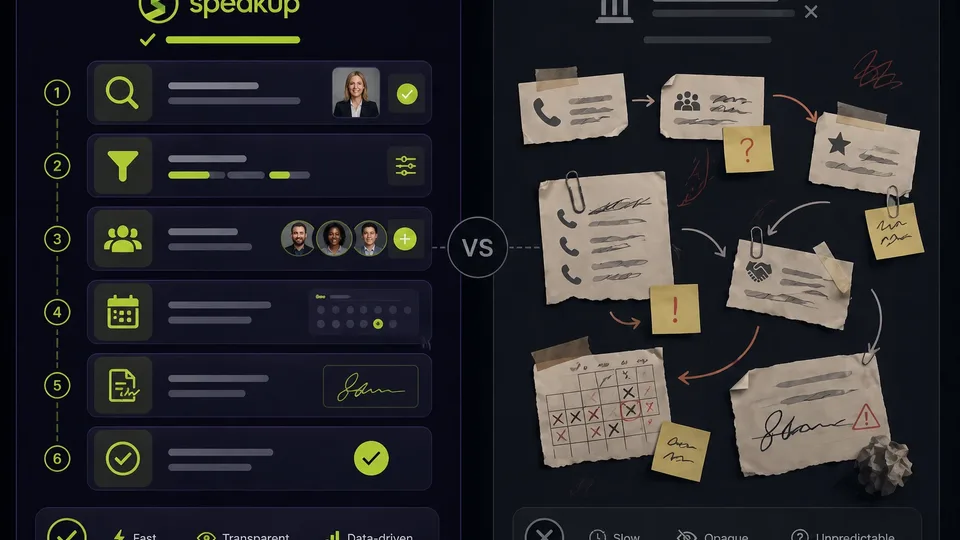
Platforms and bureaus serve different needs. Here's when to use which.
Choose a platform when:
- You want to search, evaluate, and contact speakers directly
- Your budget is under $20,000 and you want to avoid commissions
- You need a speaker quickly (AI matching can deliver results in hours)
- You're booking for a podcast, webinar, or media appearance (bureaus rarely cover these)
- You want to compare multiple options transparently
Choose a bureau when:
- Your budget is $25,000+ and you want concierge service
- You need a celebrity or extremely high-profile speaker
- You don't have time to manage the search and booking process yourself
- You want contractual protections and a dedicated event coordinator
- You've used the bureau before and trust their recommendations
Many organizers use both: platforms for most bookings and bureaus for flagship events with big-name speakers.
FAQ
Which speaker booking platform is best for event organizers?
For most event organizers, SpeakUp offers the best combination of AI matching, speaker quality, global coverage, and cost (free to use). If you specifically need tech conference CFP management, Sessionize is the standard. For US-based events needing both speakers and entertainment, GigSalad covers the broadest talent range.
Which platform is best for speakers looking to get booked?
It depends on your approach. If you want inbound opportunities (organizers finding you), SpeakUp and eSpeakers offer the strongest organizer-facing search. If you want to actively pitch and manage outreach, SpeakerHub's CRM and lead database are built for that. For business operations (contracts, invoicing, pipeline), SpeakerFlow is the most comprehensive.
Are speaker booking platforms free?
For event organizers, most platforms are free to use — including SpeakUp, eSpeakers Marketplace, GigSalad, and SpeakerHub's directory. Speakers typically pay for premium features: enhanced profiles, better ranking, outreach tools, or CRM access. Subscription fees for speakers range from $0 (basic profiles) to $400+/year for advanced business tools.
What's the difference between a speaker platform and a speaker bureau?
A speaker platform is an open marketplace where organizers search, discover, and contact speakers directly. A speaker bureau is an agency that represents a curated roster and handles the booking process for a commission (usually 20–30%). Platforms give you control and avoid commissions. Bureaus provide curation and concierge service. Most organizers benefit from starting with a platform and escalating to a bureau only for premium events.